MDH-10
Selene's Dream
Hair & Scalp Bar
Best seller
Soap for hair and the scalp beneath it. No sulfates, no silicones, nothing that strips or coats.
Shipping $6.95–$9.95 · Free over $75 · Shipping & returns
- Best for
- Anyone switching off bottled shampoo
- Use on
- Hair and scalp
- Feels like
- Clean without the squeak
How to use
- Wet hair fully.
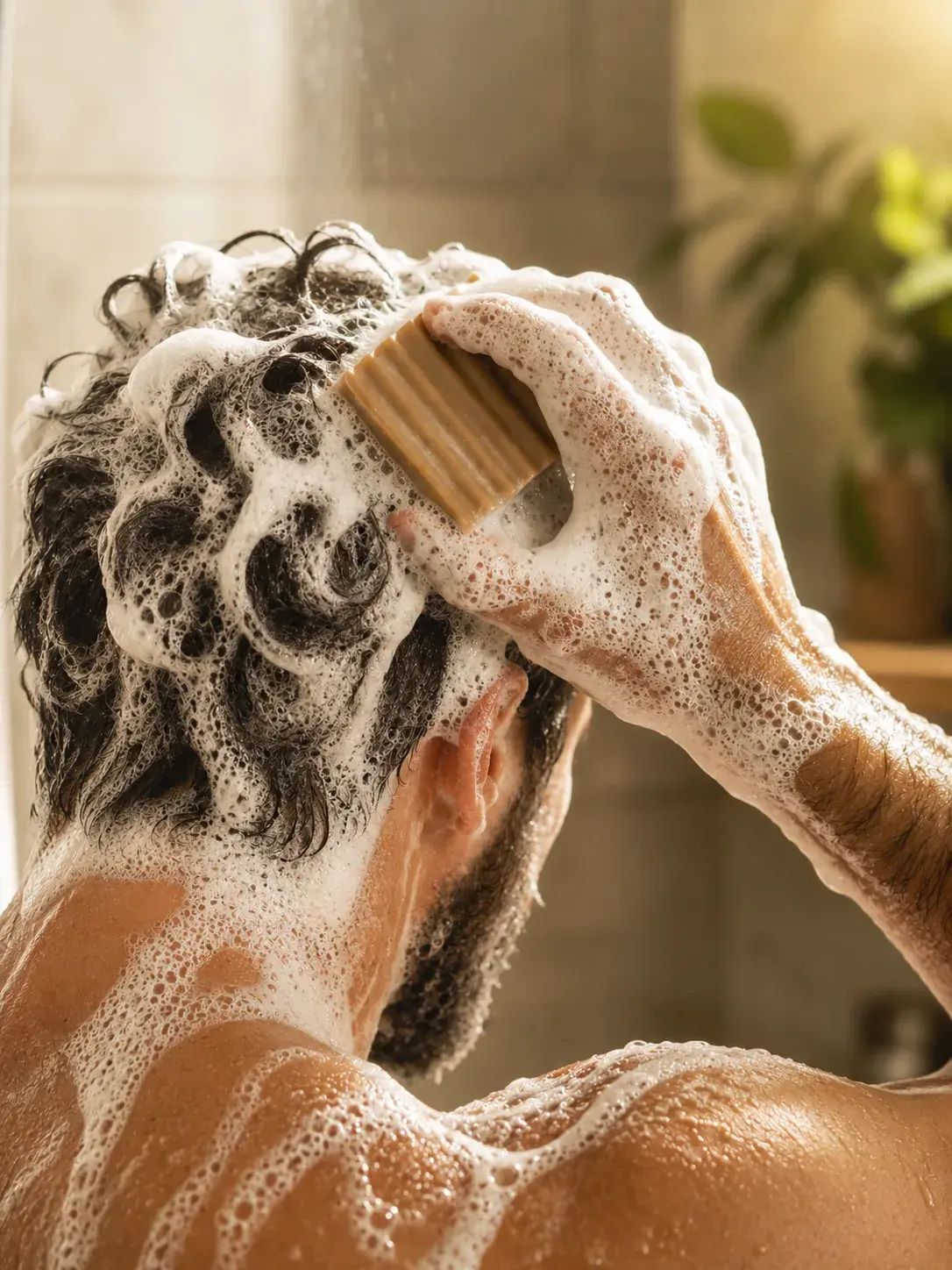
- Rub the bar between your hands or straight over the scalp.
- First pass: a quick wash, then rinse. Don't expect big suds yet — real soap spends its first lather lifting the buildup bottled products leave behind. That's it working, not failing.
- Second pass: same bar. Now the lather arrives in force. Work it in at the roots and leave it up to two minutes for best results.
- Rinse well. Let the bar dry between uses.
- Richness
- Rich
- Superfat
- 9%
- Cure
- 8–10 weeks
Wrapped in NatureFlex, a certified home-compostable cellulose film that breaks down in a home compost bin, not just an industrial facility.
Safety
For external use only. Avoid eyes and mucous membranes. Do not use on broken or irritated skin. Discontinue use if irritation occurs. Review the full ingredient list before use, especially if you have known allergies or sensitivities. Keep out of reach of children and pets.
A hair bar succeeds or fails at the scalp, and most commercial washing asks too much of it: scrub hard, rinse clean, then accept whatever coating the bottle leaves behind. Selene's Dream answers that the way hair actually asks to be handled, which is cleanly and without a film that has to be undone at the next wash.
The formula works as a system rather than a single gesture. Castor's ricinoleic acid gives the lather body and helps the foam hold. Rice bran contributes the oil structure the bar is built around, with its unsaponifiable fraction carried into the cured soap. Jojoba, a wax ester rather than a triglyceride, belongs to the richer side of the formula without behaving like an ordinary oil. The natural glycerin that handmade cold process leaves behind stays in the bar instead of being extracted and sold off separately.
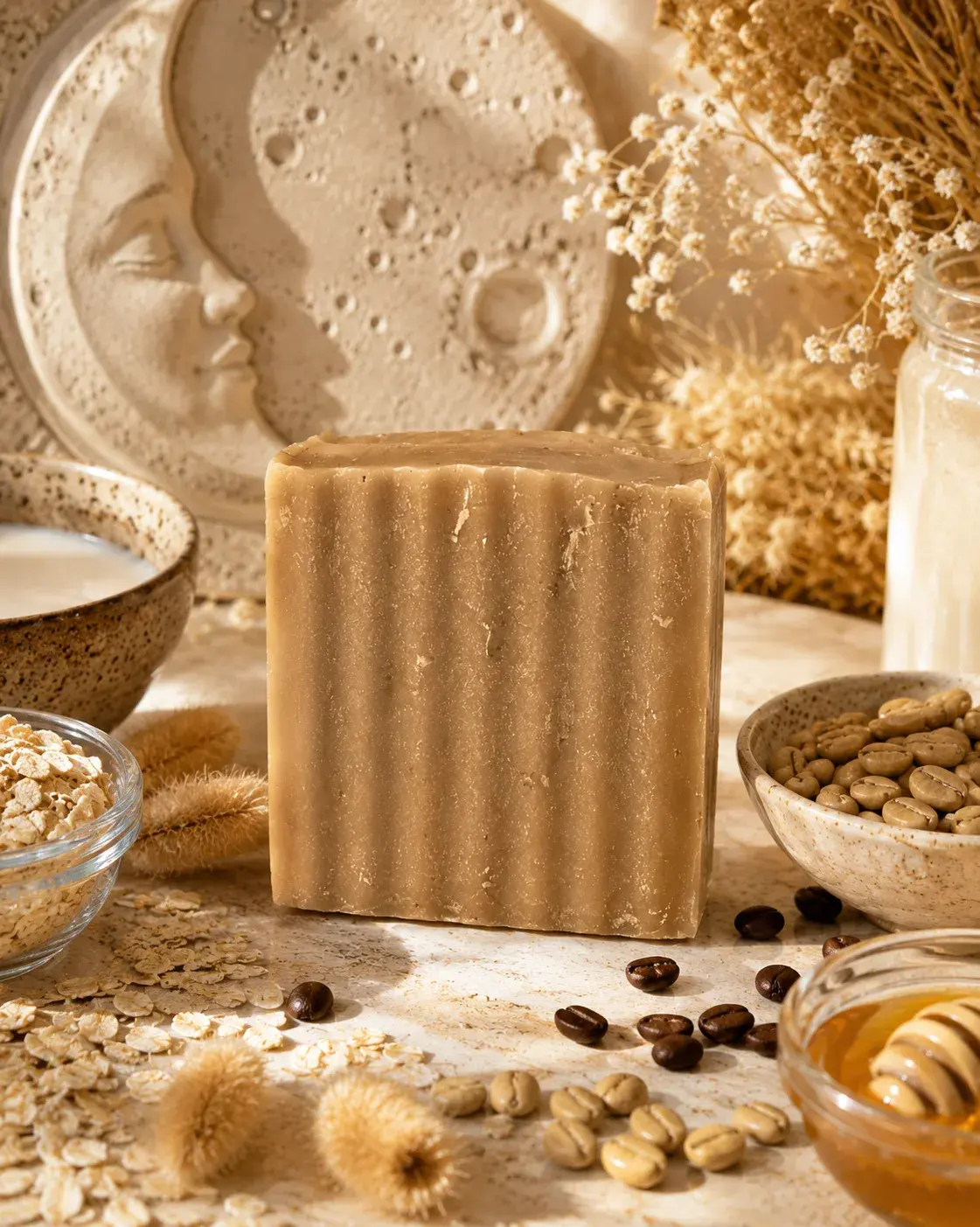
Rice threads through the whole of the bar, for a reason far older than the industry that eventually bottled it. As a child, I watched my Okinawan aunt rinse her hair in the cloudy water poured off from washing rice, a ritual the island's women had carried for generations before her. Rice is worked into Selene's Dream as part of the material identity of the bar, not as a label ornament. The rice and oats are milled into flour by hand for every batch and drawn out slowly, so that inheritance lives inside the bar rather than across a label. Oats bring their own beta-glucan-bearing material, folded into the same cold-process system.
What Selene's Dream withholds is chosen as deliberately as what fills it. No silicone to wrap the hair in a shine that builds, then dulls. No sulfate detergent system. No added fragrance. No coating the rinse has to undo. Clean where clean matters, and not one ingredient added just to fake the feeling of health.
The ingredients
Rice is the center of Selene's Dream for a reason older than the industry that eventually bottled it. As a child, I watched my Okinawan aunt rinse her hair in the cloudy water poured off from washing rice, a ritual the island's women had carried for generations before her. That memory belongs in this bar.
The rice and oats are milled into flour by hand for every batch and drawn out slowly, so the material lives inside the soap rather than across the label. Rice gives the bar its inheritance. Oats bring their own beta-glucan-bearing material into the same cold-process system. White coffee is worked into the formula itself, not used as a scent.
Castor is here for the lather structure. Jojoba is here because it is a wax ester rather than an ordinary triglyceride oil. The natural glycerin formed in cold process stays in the finished bar instead of being extracted and sold off separately.
What Selene's Dream withholds is chosen as deliberately as what fills it: no sulfate detergent system, no silicone coating, no added fragrance, and no ingredient added just to fake the feeling of health.
Full ingredients (INCI)
Sodium Ricebranate, Sodium Cocoate, Sodium Olivate, Sodium Sweet Almondate, Sodium Castorate, Sodium Shea Butterate, Aqua, Oryza Sativa (Rice) Starch Extract, Avena Sativa (Oat) Extract, Coffea Arabica Seed Extract, Camellia Sinensis Leaf Extract, Chamomilla Recutita Flower Extract, Moringa Oleifera Leaf Extract, Capra (Goat) Milk, Mel (Honey), Simmondsia Chinensis (Jojoba) Seed Oil, Sodium Lactate, Rosmarinus Officinalis (Rosemary) Leaf Extract, Stearic Acid
Full ingredients are listed for transparency. Review ingredients before use, especially if you have known allergies or sensitivities.
Sodium hydroxide is the alkali that turns oils into soap. It is fully consumed in the reaction, so none remains in the finished bar.
What is sodium lactate?
The sodium salt of lactic acid, fermented from sugar beets and then neutralized. In cold process it helps the bar set faster and cure harder, and any trace left behind works as a humectant. The FDA classifies it as GRAS. It is the same acid your own skin and muscles already make.
What is stearic acid?
Palm-free, sourced from flax and Mahua (Madhuca longifolia). In the bar it contributes hardness and a stable, lasting lather. Most commercial stearic acid is a palm derivative; closing that gap is part of being palm-free all the way down.
What is rosemary extract (ROE)?
A natural rosemary extract used in a small amount as an antioxidant. It slows the oils from oxidizing so the bar stays fresh longer. It is added for shelf life, not for scent.
The chemistry
This formula is a cold-process soap system, not a syndet shampoo system. Its primary surfactants are sodium salts of fatty acids generated in situ by alkaline hydrolysis of whole oils. That distinguishes it chemically from sulfate and sulfonate detergent systems, where the active surfactants are manufactured separately and then compounded with polymers, silicones, thickeners, chelators, fragrance, and deposition aids.
Saponification proceeds through hydroxide attack on triglyceride ester bonds. The fatty-acid chains are converted into sodium carboxylates, while the glycerol backbone is released as glycerol. The finished soap phase is therefore a mixed population of sodium oleate, sodium linoleate, sodium laurate, sodium myristate, sodium palmitate, sodium stearate, sodium ricinoleate, and related salts determined by the oil blend.
The fatty-acid profile determines the physical chemistry of the bar. Laurate and myristate increase solubility and lather intensity. Oleate and linoleate contribute the more unsaturated C18 portion of the soap phase. Palmitate and stearate contribute hardness and lower solubility. Ricinoleate, derived from castor oil, is structurally unusual because ricinoleic acid carries a hydroxyl group at C12. That added polarity changes the behavior of the sodium salt in water, especially foam density, viscosity, and persistence.
Any jojoba present should be treated separately from the triglyceride oils. Jojoba is dominated by long-chain monoester waxes, not glycerol-bound fatty acids. Under alkaline soapmaking conditions it does not behave as a conventional base oil with the same saponification logic as coconut, castor, rice bran, olive, almond, or shea. Its most relevant role is in the residual wax-ester/non-soap fraction of the finished bar.
Rice and oat materials contribute carbohydrate, protein, mineral, and minor phytochemical fractions depending on grind, extraction, hydration, and exposure to alkali. Oat beta-glucan is a mixed-linkage beta-(1,3)(1,4)-D-glucan, a high-molecular-weight polysaccharide rather than a lipid or surfactant. Rice starch is composed primarily of amylose and amylopectin. Inositol and free phenolic acids are not chemically robust under strong alkaline conditions, so the defensible chemistry is partial extraction, suspension, hydration, and alkaline modification, not intact transfer of every native grain compound.
White coffee contributes coffee-derived solids and soluble fractions according to preparation method. Caffeine is relatively alkali-stable compared with many phenolics, while chlorogenic acids, ferulic acid derivatives, lipids, proteins, carbohydrates, and roast-derived compounds vary in alkaline stability. The bar should therefore be described as containing white coffee material processed through saponification, not as preserving the complete chemistry of raw white coffee unchanged.
Cure is a physical-chemical stage, not a continuation of primary saponification indefinitely. Most triglyceride conversion occurs early. Cure reduces water, increases relative soap concentration, allows crystalline and semi-crystalline soap domains to develop, improves hardness, and changes dissolution rate. A longer cure changes the material properties of the bar even after the main reaction is substantially complete.
Sodium lactate is present as a process salt. It modifies the aqueous phase and finished matrix by affecting water activity, ionic strength, crystallization behavior, unmolding, and hardness. It is structurally and functionally separate from the fatty-acid salts created by saponification.
The final bar is a cured mixed sodium fatty-acid salt system containing retained glycerol, reduced water, calculated residual lipid, sodium lactate, white coffee material, grain-derived carbohydrate fractions, and minor oil-borne unsaponifiables. It contains no sulfate surfactant system, silicone phase, cationic polymer deposition system, or synthetic detergent base.
The stories that connect us
Selene was the moon herself, not a goddess who lived on it but the thing in the sky, driving her silver chariot across the dark every night while the world slept beneath her. She had seen everything there was to see from up there, and none of it had ever stopped her, until one night it did. In a cave on the slope of Mount Latmos a shepherd named Endymion lay sleeping among his flock, and his beauty was such that the moon came down out of her own sky to look at him, and could not bring herself to leave.
He was mortal, which was the whole trouble. Mortals grow old and mortals die, and Selene could not stand the thought of a world that would one day take him out of it. So she went to Zeus and asked that Endymion be spared old age and death, and Zeus granted it the only way a god ever grants such a thing, with a price folded inside the gift. Endymion would never age and never die, but he would never wake again either. He was laid down in his cave in an endless sleep, beautiful forever, dreaming forever, and every night without fail Selene came down from the sky to be with him. She is still coming down. The dream the bar is named for is his, the long sweet sleep at the foot of the mountain, and the devotion is hers, a love that returns again and again and never misses a night.
It is a shepherd's story, and there is a shepherd's gift in the bar, the goat milk that has softened skin for as long as people have kept flocks. The same moon that hung over that cave hung over Japan, where women had been rinsing their hair in the cloudy water left from washing rice for longer than anyone can rightly say, a practice carried quietly from mother to daughter across centuries. My aunt is from Okinawa, and she is how it reached me, and the bar grew out of what she handed down. That is the thread that ties all of it together. Devotion is a thing done gently and done again, whether it is a goddess returning to a mountain every night or the women of a family keeping a small ritual alive until it arrives, at last, in your hands.