
MDA-05
New Moons
Clarifying Bar
The facial bar's lean sibling: the same base held at the line's leanest superfat, for skin that runs oily. It cleans thoroughly, rinses completely, and leaves the least behind.
Shipping $6.95–$9.95 · Free over $75 · Shipping & returns
- Best for
- Skin that runs oily by afternoon
- Use on
- Face
- Feels like
- Light — rinses to nothing
- Richness
- Light
- Superfat
- 5%
- Cure
- 4–6 weeks
Wrapped in NatureFlex, a certified home-compostable cellulose film that breaks down in a home compost bin, not just an industrial facility.
Safety
For external use only. Avoid eyes and mucous membranes. Do not use on broken or irritated skin. Discontinue use if irritation occurs. Review the full ingredient list before use, especially if you have known allergies or sensitivities. Keep out of reach of children and pets.
New Moons is for the face that feels heavy by afternoon. It does not need a richer wash. It needs less left behind. New Moons is tuned in the opposite direction from its facial sibling: where Call of the Pleiades holds a rich 9% superfat, New Moons is held at 5%, the leanest bar we make.
Superfat is the share of oil left beyond what the lye converts into soap, and it decides how much residual lipid remains in the finished bar. The lower it sits, the less oil remains outside the soap phase and the cleaner the rinse feels. At 5%, enough remains that this is still a whole-oil soap, its natural glycerin intact, but only just. That restraint is the entire design.
Same materials, different proportions, the powders milled to their finest grades so nothing scours. Rich enough to stay composed. Lean enough to leave the face feeling clean, clear, and unweighted.
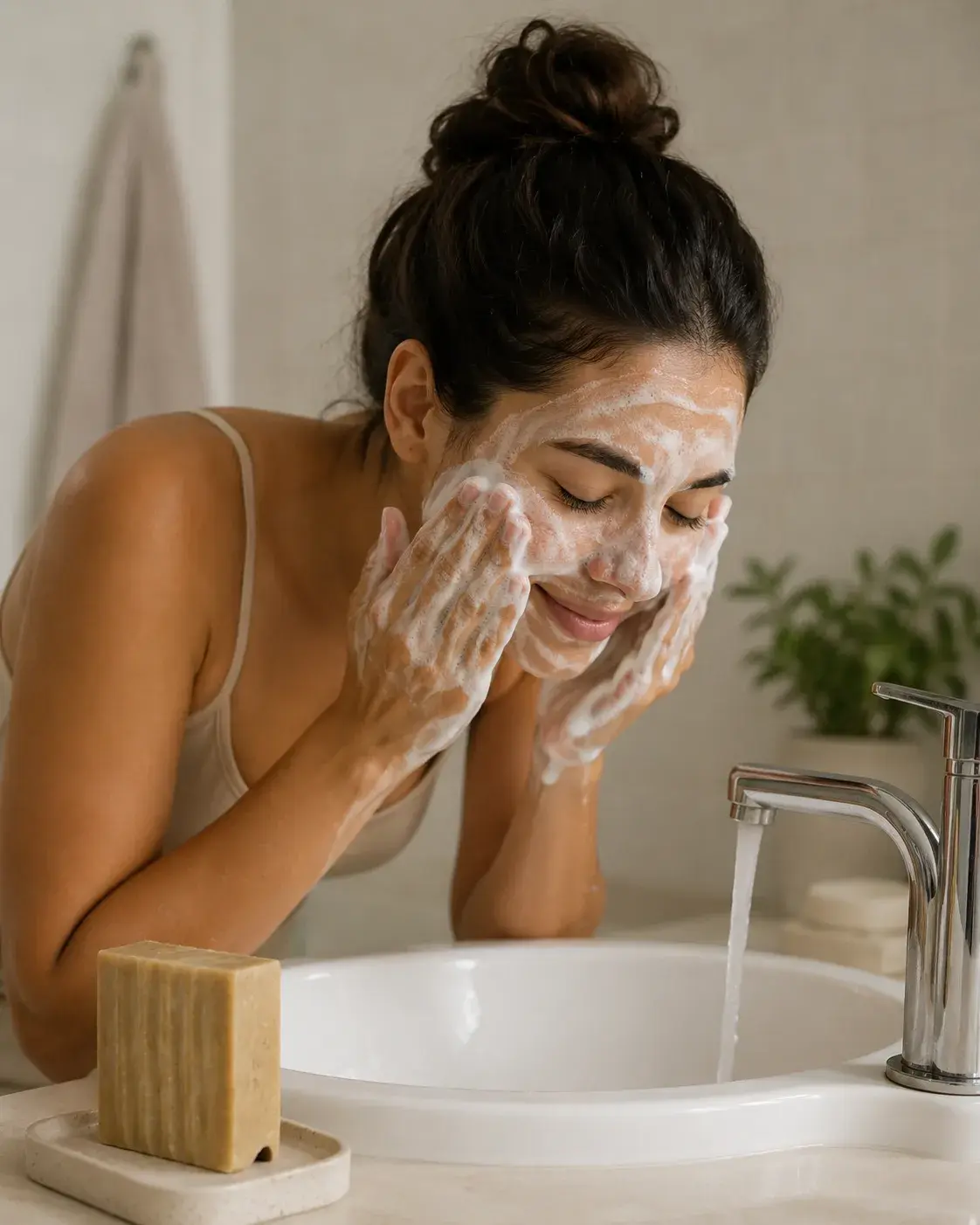
The ingredients
New Moons is the leanest facial bar in the line. Its ingredient story is not about adding more. It is about holding back.
Where Call of the Pleiades is rich, New Moons is restrained. The bar is held at 5% superfat, so less oil remains outside the soap phase in the finished bar. The powders are milled to their finest grades so the bar stays smooth rather than scrubby.
This is the lighter facial bar: lower superfat, fine materials, clean rinse, and no added fragrance. It keeps the Moondog material logic intact while leaving the finish lighter than its richer facial sibling.
Rich enough to stay composed. Lean enough to leave the face feeling clean, clear, and unweighted.
Full ingredients (INCI)
Sodium Ricebranate, Sodium Cocoate, Sodium Olivate, Sodium Sweet Almondate, Sodium Castorate, Sodium Shea Butterate, Aqua, Oryza Sativa (Rice) Starch Extract, Avena Sativa (Oat) Extract, Coffea Arabica Seed Extract, Camellia Sinensis Leaf Extract, Chamomilla Recutita Flower Extract, Moringa Oleifera Leaf Extract, Capra (Goat) Milk, Mel (Honey), Simmondsia Chinensis (Jojoba) Seed Oil, Sodium Lactate, Rosmarinus Officinalis (Rosemary) Leaf Extract, Stearic Acid
Full ingredients are listed for transparency. Review ingredients before use, especially if you have known allergies or sensitivities.
Sodium hydroxide is the alkali that turns oils into soap. It is fully consumed in the reaction, so none remains in the finished bar.
What is sodium lactate?
The sodium salt of lactic acid, fermented from sugar beets and then neutralized. In cold process it helps the bar set faster and cure harder, and any trace left behind works as a humectant. The FDA classifies it as GRAS. It is the same acid your own skin and muscles already make.
What is stearic acid?
Palm-free, sourced from flax and Mahua (Madhuca longifolia). In the bar it contributes hardness and a stable, lasting lather. Most commercial stearic acid is a palm derivative; closing that gap is part of being palm-free all the way down.
What is rosemary extract (ROE)?
A natural rosemary extract used in a small amount as an antioxidant. It slows the oils from oxidizing so the bar stays fresh longer. It is added for shelf life, not for scent.
The chemistry
This formula is chemically distinguished by a lower superfat. The process remains cold-process saponification: sodium hydroxide hydrolyzes triglyceride oils, producing glycerol and sodium fatty-acid salts. The distinction is the ratio of converted soap salts to residual non-soap lipid in the cured matrix.
Superfat is determined by stoichiometry. Each oil has a saponification value based on the amount of alkali required to convert its triglyceride content into soap. When the sodium hydroxide charge is calculated below the full SAP requirement, some lipid material remains unconverted. A lower superfat reduces that residual fraction and increases the relative proportion of sodium fatty-acid salts in the finished bar.
The soap phase is a mixed carboxylate system. Laurate and myristate salts contribute solubility and lather. Oleate and linoleate salts contribute the unsaturated C18 fraction. Ricinoleate contributes hydroxylated fatty-acid salt behavior. Stearate and palmitate contribute structure, hardness, and lower solubility.
A lower-superfat soap should not be confused with a synthetic detergent system. The surfactant phase is still produced from whole oils by alkaline hydrolysis. What changes is the lye discount and resulting residual lipid load, not the basic chemical class of the cleanser.
Fine powders, extracts, infusions, and particulates have different chemical identities and should not be collapsed into one category. A powder is a suspended solid. An extract is a soluble or semi-soluble fraction pulled from a raw material into a solvent. An infusion is an aqueous extraction. A particulate contributes physical matter according to particle size. A mineral such as clay is chemically distinct from plant powder, coffee, honey, or rice material.
Cold-process glycerol remains in the bar as a reaction product. Cure reduces water and changes hardness, dissolution rate, and matrix organization. Sodium lactate, where used, acts as a process salt affecting water behavior, mold release, firmness, and cured hardness.
The cured material is therefore a lower-superfat mixed sodium fatty-acid salt matrix containing retained glycerol, reduced water, a smaller residual lipid fraction, sodium lactate where used, declared fine-grade additives, and oil-borne unsaponifiable fractions.
The stories that connect us
The new moon is the one night the moon gives the sky back to the stars. It goes dark, slips between the earth and the sun, and for a night it cannot be seen at all, and then it begins again, a thread of light that grows back to full over the weeks that follow. Every culture that ever watched the sky made the same thing of it. The new moon was the turn of the cycle, the clean slate, the night you draw a line and start over. It was when the old month ended and the next was counted from, the dark before the return.
That is the idea the bar is built on, the reset, the clearing-away that has to come before anything fresh begins. It is the one bar in the line made to take something off rather than leave something behind, the leanest pour we make, washing away what the day built up until the skin is given back to itself. The moon empties so it can fill again. This bar clears the way for the same kind of return.